Cortex Prime’s new stewardship opens up the system
Cam Banks still has a lot of work he wants to do.

Cam Banks has been working on the Cortex system for over fifteen years. While Jamie Chambers first developed Cortex (now called Cortex Classic) while at Margaret Weis Productions, Banks took over for the second edition, and Cortex Plus was released in 2010. Despite the similar names, it should be noted that these are very different systems, with Plus streamlining the system for even easier porting into big IPs. In 2012, Marvel Heroic Roleplaying, written by Banks, which used Cortex Plus, won an ENNIE.
Then, in 2016, Banks was able to license the system, taking over the development of an updated edition, and MWP stepped back. The 2017 Kickstarter stated that this edition “embraces its roots as a means of adapting your favorite movies, television shows, and comic books, while emerging finally as a truly multi-genre modular roleplaying game in its own right.”
And then, in 2019, MWP sold the rights wholecloth to Fandom—the same company which, at the time, was in charge of D&DBeyond. There were plans to expand Cortex while at Fandom, with Cam Banks having been hired as the Cortex Creative Director. Cortex Prime won multiple ENNIES in 2021 and 2022. In 2022 Tales of Xadia—the tie-in RPG for the Netflix animated show The Dragon Prince—was released.
But the rights for Cortex weren’t done changing hands—when Fandom sold D&DBeyond to Wizards of the Coast in 2022 the rights for Cortex were sold to Dire Wolf Digital that same year. Dire Wolf pledged to uphold the promises of that 2017 Kickstarter, specifically the Prime Spotlights. While digital versions of the spotlights were sent out to backers in 2024, about 350 people who pledged for physical volumes of the Spotlights had their pledges unfulfilled.
Banks announced this in a Kickstarter update, explaining that the rights had changed hands twice between the Kickstarter funding and Dire Wolf was unable to fulfill the physical production of Spotlights. It was met with disappointment, but many backers recognized what a trial Cortex Prime—and Banks himself—had been through.
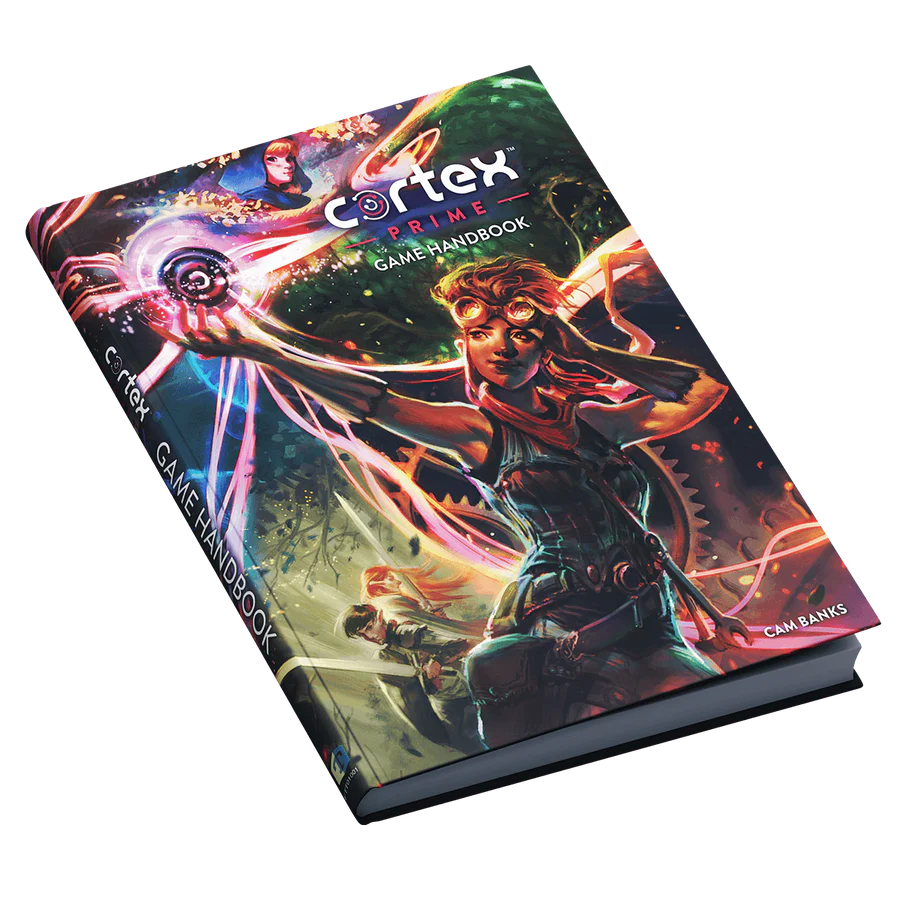
But now, Banks has been able to meaningfully acquire decision-making power with regards to the rights for Cortex Prime. Dire Wolf still owns the game, but Banks, and his company, Rusty Sellsword, have been able to create a sub-license deal that opens the system up to “community and commercial projects, with direct digital distribution via DriveThruRPG,” according to the press release.
We were able to send Banks some questions via email about Cortex Prime, the development history of the game, and what this new sub-licensing deal means for both the game and for him.
Lin Codega: How long have you been working on Cortex Prime?
Cam Banks: Cortex Prime, as an idea for a unified and updated version of the various Cortex rules I’d been working on for Margaret Weis Productions, first took shape in 2016. I signed a license with MWP to create new Cortex stuff as they’d stepped away from RPG publishing, and so that resulted in the eventual Kickstarter. So, it’s been 10 years.
Codega: Can you tell us about the game’s development history?
Banks: It goes back to a game called Sovereign Stone that Larry Elmore, Lester Smith, and Don Perrin created with Margaret Weis and Tracy Hickman. This was a step-die system in Larry’s fantasy world and while it was later converted to d20 with the arrival of D&D 3rd edition, those rules served as the basis for the Serenity RPG that MWP released in 2005. Other licenses followed, like Battlestar Galactica and Supernatural, and by that stage the system was being called Cortex. I stepped in around this time to lead development on games like Leverage and Smallville, which changed the rules quite a bit while keeping the step-dice and plot points and so on. With Marvel Heroic and Firefly, this “Cortex Plus” era gave me the collected rules that I used to create the Cortex Prime toolkit that’s around today. Fandom bought Cortex from MWP, so I went to work for them. Then Dire Wolf Digital bought it from Fandom.
Codega: What’s different about the terms of the new licensing agreement versus the one Dire Wolf had established?
Banks: The previous license was established by Fandom during their ownership of Cortex, and Dire Wolf inherited it when they acquired the property. That license was essentially a fan content policy; it acknowledged that people wanted to share their stuff online, but commercial publishing wasn't really part of the picture. This new arrangement is between Dire Wolf and me directly, and the big change is that I can now sublicense to third-party creators who want to make and sell their own Cortex content.
Codega: Were there community problems with the first Cortex Prime license as Dire Wolf envisioned it?
Banks: I think folks expected something open like Creative Commons or OGL from Fandom, and what they got wasn't that, so yeah, there was a reaction. The goal was really just to let fans post their stuff online, not to open up commercial publishing. That never happened. Under this new arrangement it can, though it's not an open license. It’s got more in common with creative content stuff at DriveThruRPG.
Codega: Do you have collaborators in mind?
Banks: There are designers I've wanted to work with for years—people who were excited about Cortex back when its future was uncertain and stayed patient through all of it. I'm also eager to bring in voices that haven't had a Cortex platform before. One of the things I want to avoid is Cortex feeling like a closed club. The more interesting games people make with it, the better the system gets.
Codega: Was it always the plan to become the license steward?
Banks: Honestly, no. There was a real period where I wondered if my time with Cortex was just done. But when Dire Wolf approached me I realized I still had a lot I wanted to do with it. It feels pretty good.
Codega: Will Cortex Prime have another tentpole game like Tales of Xadia?
Banks: High-end licensed games have always been my gig, but I think it’s time for some Cortex games that aren’t as tied to big IP. There are three settings in the Cortex Prime book that I always intended on expanding into full games: TRACE, Hammerheads, and Eidolon. That’s one of my big goals now.
Codega: Can you give us a hint about the new Cortex Prime content that you’re going to be revealing soon?
Banks: The best news out of this new deal is that finally, a lot of material that was produced solely for the Kickstarter and its backers is being made available to everyone. Cortex Prime needs games, not just a box of LEGO, and so that’s the focus for me going forward.